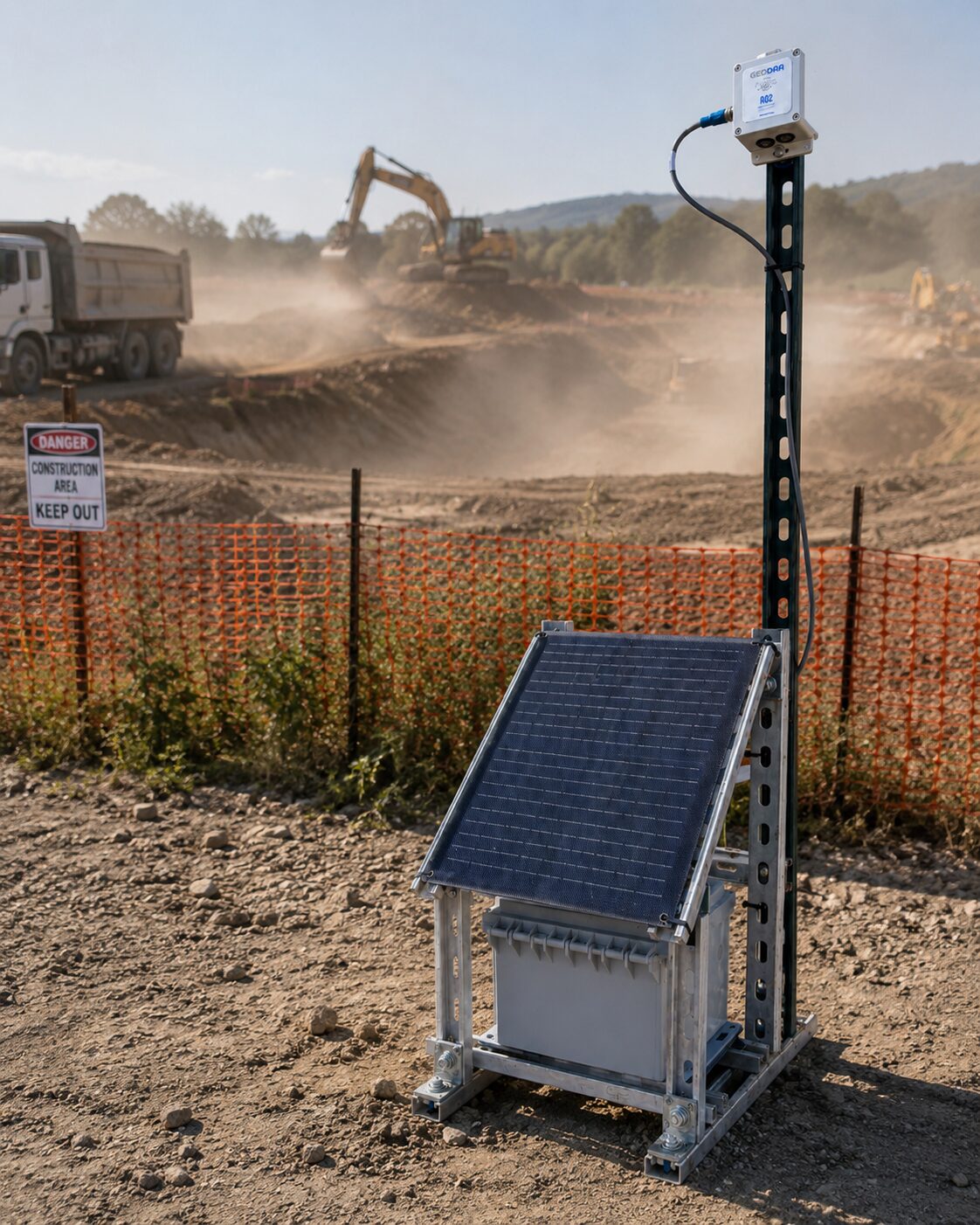

Application Overview
Geodaq provides complete air quality and dust monitoring systems and services for construction, demolition, earthwork, remediation, industrial, and environmental monitoring applications. The AQ2 air quality and dust monitor is part of the RADAQ Remote Automated Data Acquisition system and is designed for continuous unattended monitoring of airborne particulate and environmental conditions at active project sites.
AQ2 monitoring stations measure PM1.0, PM2.5, PM4, PM10, VOC index, NOx index, relative humidity, and temperature. Battery- and solar-powered stations transmit results to a secure cloud server for real-time review, threshold notifications, and automatic PDF reporting through the Geodaq web application.
Monitoring services include field installation, remote system configuration, threshold notifications, instrumentation plans, report generation, and technical support for interpreting air quality and dust monitoring results.
Real-Time Air Quality and Dust Monitoring Services
Geodaq air quality monitoring services help project teams document site conditions, manage dust-generating activities, respond to complaints, and demonstrate compliance with project-specific environmental requirements. Systems can be deployed for short-term construction activities or long-term continuous monitoring at site boundaries, nearby residences, schools, hospitals, offices, sensitive receptors, or occupied structures.
Results are available through a secure web application with real-time particulate and air quality plots, threshold comparisons, station health information, and automated reporting.
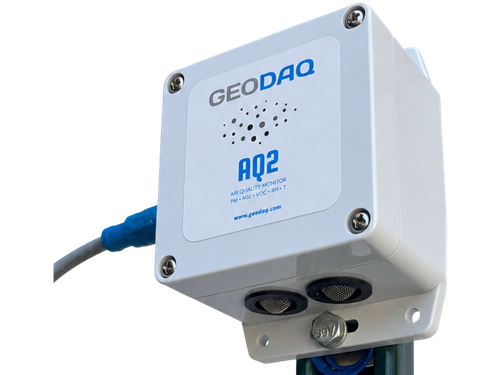
AQ2 Air Quality Meter
Robust waterproof housing with PM1, PM2.5, PM4, PM10, VOC, NOx, humidity and temperature
AQ2 Performance
The AQ2 is a digital air quality monitoring module designed for continuous, unattended outdoor measurement of particulate, gas-phase, humidity, and temperature conditions. Using an integrated laser-based environmental sensor platform, the AQ2 supports site perimeter monitoring where real-time action levels, automated alerts, and remote reporting help project teams manage changing air quality conditions.
The AQ2 measures PM1.0, PM2.5, PM4, PM10, VOC index, NOx index, relative humidity, and temperature. The following table summarizes the AQ2 measurement parameters and performance specifications.
| Parameter | Specification |
| Particle Size Range | PM1.0, PM2.5, PM4.0, PM10 |
| Mass Concentration Range | 0 to 1,000 µg/m³ |
| Mass Precision (PM1 / PM2.5) | ±5 µg/m³ AND 5% m.v. (0–100 µg/m³) ±10 % m.v. (100–1000 µg/m³) |
| Mass Precision (PM4 / PM10) | ±25 µg/m³ (0–100 µg/m³) ±25 % m.v. (100–1000 µg/m³) |
| Sensor Lifetime | >10 years (Continuous 24h operation) |
| VOC Index | 1 to 500 VOC Index points |
| NOx Index | 1 to 500 NOx Index points |
| Response Time (τ63) | <10 seconds |
| Temperature Accuracy | ±0.45 °C (Typical) |
| Humidity Accuracy | ±4.5 %RH (Typical) |
| Operating Temperature Range | -10 °C to +50 °C |
| Technology | Sheath-flow (Antifouling) Design |
| Calibration | Factory calibrated; Factory-Verified Precision and Reference Alignment |
| Self-Diagnostics | Real-time fan speed and laser health monitoring |
AQ2 Remote Air Quality and Dust Monitoring Station
The AQ2 is a compact remote air quality module designed for continuous outdoor monitoring of particulate matter and environmental conditions. It connects with the GCM8 monitoring station to provide automated data collection, wireless transmission, remote configuration, and integration with other RADAQ monitoring sensors.
The AQ2 uses an integrated environmental sensor platform with factory-calibrated particulate, gas-phase, humidity, and temperature measurements. An internal sheath-flow air curtain helps protect the laser and optics from dust buildup, reducing measurement drift during long-term monitoring at active construction sites.
Each station can operate from battery and solar power for unattended field deployment. Data is automatically transmitted to a secure cloud server where project teams can view results, receive alerts, and generate reports.
AQ2 Features