

Overview
Identify Movement and Reduce Risk
The R2D3 remote monitoring station measures absolute displacements in 3 directions (XYZ) as well as rotational movements in 2 horizontal directions. Millimeter-level displacement precision is achieved using streaming GNSS correction data and R2D3 software algorithms operating in a feedback loop. A two-axis high-performance tilt sensor measures rotational movements below 0.005 degrees.
Integrated Monitoring and Edge Processing
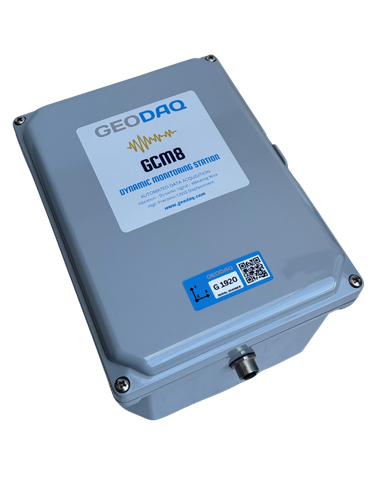
At the core of the station is the GCM8 controller, a dual-core 32-bit data acquisition and communications platform designed for high-frequency sampling, local processing, and secure remote data transmission. In addition to supporting externally connected data acquisition modules and sensors, the GCM8 can include internally mounted sensors for three-axis vibration monitoring, GPS position documentation, and high-resolution tilt measurement.
Internal tri-axial geophone
For vibration monitoring applications, the station may be equipped with an internal high-sensitivity tri-axial geophone to create a compact, self-contained monitoring system for blasting, pile driving, demolition, heavy construction, and structural response monitoring. The station can also support externally mounted geophones or velocity sensors when sensor placement away from the enclosure is required.
For temporary ground-surface installations, four threaded spikes can be mounted at the bottom corners of the GCM8 enclosure to improve coupling with the ground surface.
Internal GPS Sensor
Each GCM8 Dynamic Monitoring Station is equipped with an internal GPS sensor and antenna to record latitude, longitude, and altitude coordinates for documenting the location of each monitoring station and associated vibration measurements. GPS position logging can be enabled or disabled remotely at any time during the monitoring period.
Internal High-Resolution Tilt Sensor
The GCM8 can be equipped with a high-resolution tri-axial tilt sensor module to establish the orientation of the internal tri-axial geophone and monitor changes in rotation when the station is mounted to structural elements or other non-ground-surface locations. This provides a direct measurement of the horizontal and vertical orientation of the vibration sensor.
With a tilt resolution of less than 0.006 degrees, the GCM8 can document small rotational changes that may occur during vibration-generating activities or over longer monitoring periods.
Depending on configuration, the GCM8 Dynamic Monitoring Station can support up to three external tri-axial velocity sensors or geophones, allowing synchronized multi-point vibration monitoring from a single gateway.
Rugged Field Deployment
The station is designed for long-term field deployment in harsh outdoor environments. The weatherproof enclosure protects the controller, communications hardware, power management electronics, and optional internal sensors from dust, water, and weather exposure.
For projects requiring flexible monitoring locations, the GCM8 can be supplied as a portable remote monitoring station mounted on a sturdy field stand. The portable configuration includes an integrated battery, solar panel, and charge controller for continuous unattended operation where fixed site power is not available. This allows the monitoring station to be relocated around the project perimeter or moved to different work areas as construction activities change.
The enclosure is suitable for direct mounting to walls, poles, posts, structural members, or the portable field stand, allowing the station to be installed where monitoring is required while minimizing site disruption and setup time.
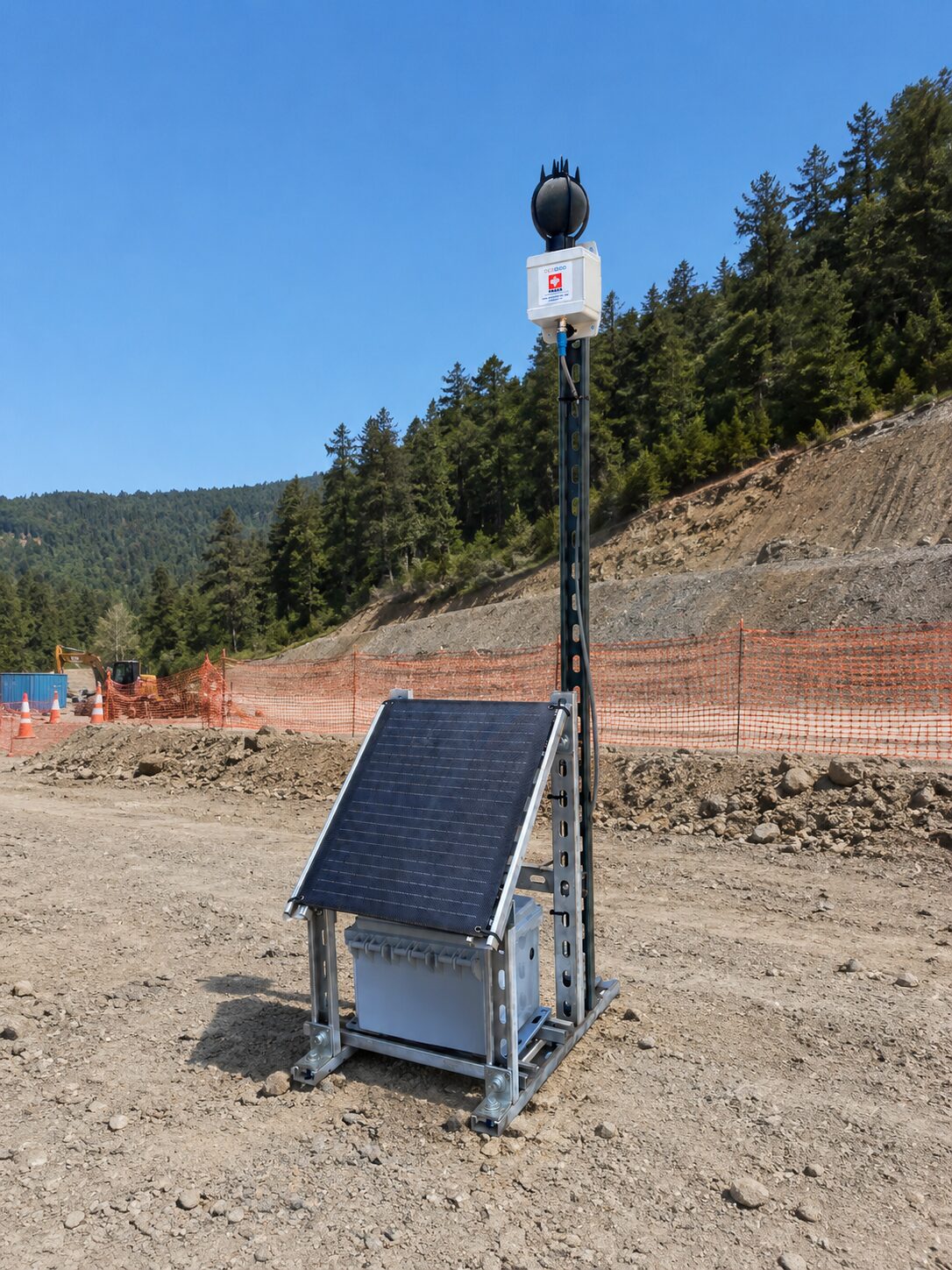
Portable Remote Monitoring Station with Solar Power System
Power and Health Monitoring
Installation Benefits
Monitor Additional Sensors
The GCM8 Dynamic Monitoring System has significant monitoring capability with 16 vibrating wire inputs and 16 static or dynamic analog voltage inputs. Each analog input channel accommodates unipolar or bi-polar inputs, variable input ranges, and sample rates up to 30,000 samples per second per channel on all 8 inputs. Add piezometers, displacement transducers, strain gauges, accelerometers, geophones or any vibrating wire or voltage output sensor.

JETDAQ MODULE
High-Speed 8-Channel DAQ with Programmable Gain Amplifier (PGA) and Overvoltage Protection on all Inputs
RADAQ Module Expansion
The GCM8 Dynamic Monitoring Station also serves as a gateway for the RADAQ Remote Automated Data Acquisition ecosystem. RADAQ modules allow the station to be expanded beyond vibration monitoring to include air quality, noise, GNSS position monitoring, and other sensor types.
Sensor data from connected modules can be time-synchronized and transmitted to a secure cloud platform using a carrier-agnostic 4G LTE connection. This unified data stream allows project teams to review vibration, noise, dust, position, and geotechnical data from a single remote monitoring system.
| RADAQ | DESCRIPTION |
| GEO3 | Tri-Axial Geophone or MEMS Velocity Sensor for Vibration Monitoring |
| ST500 | Sound Level Node for Outdoor Noise Monitoring |
| R2D3 | High-Precision GNSS Position Monitoring in 3 Directions (XYZ) |
| AQ2 | Air Quality Sensor Node for Dust Monitoring |
Typical Applications
Key features of the GCM8 Dynamic Monitoring Station include:
| Application | Measurements and Features |
| Construction Vibration | PPV, frequency, event waveforms, unattended monitoring, automatic report generation |
| Landslide Movement | High-precision GNSS three-dimensional displacement and movement trends |
| Construction Noise | Sound level, time history, exceedance documentation |
| Dust and Air Quality | PM1.0, PM2.5, PM4, PM10, environmental conditions |
| Excavation Support | Strain gauges on struts, walers, rakers |
| Blasting | Vibration levels, frequency and peak stresses |
| Structural Health | Multi-point displacement, velocity and strain |
| Dams | Piezometers, GNSS displacement |
| Pile Testing | Load, displacement, vibrating wire and electrical resistance strain |